

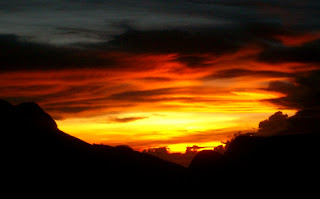
Above: Sunrise at the summit of Mt. Kinabalu on May 6, 2010
On May 4, I left Singapore for Kota Kinabalu in Sabah, East Malaysia, on yet another one of my do-it-yourself (D-I-Y) adventures - this time, a climbing expedition to Mt. Kinabalu.
If I can do it, DIY is always my preferred route. In this case, the trick was to secure the night's (mandatory) accommodation at Laban Rata camp (@ elevation 3,273 m or 10,738 ft) on Mt. Kinabalu first and foremost as accommodation there was limited and often sold out quickly. Some tour agencies charge an all-in price of about MYR850 to MYR1000 (between ~US$265 and ~US$312) per person but I managed to secure the accommodation, meals, climbing permit and insurance for a considerably lower price of MYR492 (~US$153) per person directly with the owner-operator, Sutera Sanctuary Lodge (SSL). E-mail: sslmresv2@suteraharbour.com.my; www.suteraharbour.com. Throughout the reservation process (via e-mail), the staff at SSL was nothing less than polite, prompt and professional. Other costs not included in the quote were: (1) Guide - MYR85 (you pay for one at the Park HQ), (2) Transport to/from the Park HQ and Timpohon Gate - MYR33, (3) Public (van) transport to/from Kota Kinabalu town and Kinabalu Park - MYR30. All in all, the total cost for me to climb Mt. Kinabalu came up to MYR640 (~US$200).


Above right: Laban Rata restaurant @ elevation 3,273 m or 10,738 ft
The climb on May 5 was tremendously taxing - perhaps it was the fever and malaise feeling I had going in or that I underestimated the difficulty and intensity of the ascent (and descent), but I definitely got a thrashing from Mt Kinabalu. From the Timpohon Gate, at elevation 1,866 m or 6,122 ft, it took me and my rather blasé guide, Rashid, about 5 hours to climb up to Laban Rata restaurant and camp at elevation 3,273 m or 10,738 ft. Rashid was of little value to me but since it's a park requirement to have a guide, he shadowed me for 24-hours.
My embattled body felt foreign to me at Laban Rata camp - my mind was incoherent and my head was banging; my legs were sore to the core and both my hands were swollen (peripheral edema) and could not write. Where were the coca leaves when you needed them?? After a somewhat satisfactory buffet dinner at 5 PM (I was more tired than hungry at that point), I walked up to my assigned Panar Laban hut to rest. Between 6:30 PM and 1:30 AM, I had to rise three times to relief myself. Perhaps it was the elevation but 3 times was a bit much. It was such an inconvenience to have to get up from bed, put on my head lamp, climb down from the upper bunk bed, put on my shoes, and then walk a brief distance to the outhouse nearby to answer nature's calls. As a result, I remained tired and miserable as I did not get a very good night's sleep.


Above left: Panar Laban hut; Above right: @ the start @ Timpohon Gate. Elevation 1,866 m / 6,122 ft


Above left: Wild edible berries, compliments of Mt. Kinabalu; Above right: A nepenthe of Borneo


At 2 AM on May 6, most of us had gathered at the restaurant to eat a light breakfast before we set off to climb the remaining 800+ m or 2,600+ ft to the Low's Peak summit. Truth be told, I was fatigued and not very enthused about the climb but I persevered. With one step after another, and frequent breaks in between to catch my breath in high elevation territory, I made my way to the top. Midway, though, the lower right back of my head started to hurt a lot and, call me hypochondriac, I was concerned that I might suffer a stroke. Pain, as I've learned, was debilitating and all I thought about. I had to stop a few times to lower my head to get some blood flowing there in the hope of alleviating the pain. I also took many sips of water to stay hydrated. I was the slow tortoise - slowly but surely I made my way up, even in rough sections where I had to pull myself up with the rope.
Still, there was a moment of weakness when I thought of giving up. My head was banging and I was simply too tired to continue. Coincidentally, at the precise moment when I thought about giving up, I felt this huge gush of wind pushed me strong from behind. I kid you not, God was watching over me. I soon overcame my pessimistic thoughts and held on with all I got. Success usually occurs when the heart takes over and that was exactly what happened to me. I was reminded that whenever we go through physical torments, such as the marathon run I did last year, it's always the heart that remains the strongest. The mind will turn negative and the body will scream murder but it's the heart that will keep on going. When I arrived at the base of Low's Peak, the sun's first rays of the day were starting to shine through. No words could describe how I felt when I saw those stupendous colors for the first time. It was beyond "WOW". In spite of my headache and nausea feeling, I felt God's grace all around me. I learned that it's not about the summit anymore. It's the climb that mattered - each step took me to the summit. The climb, like in life, was all about overcoming struggles and adversity to reach one's goal.
The descend down to the Park HQ that same day on May 6 was yet another challenge. I don't usually gripe and complain but this was one experience I would not forget. Compared to other descends, this one from Mt. Kinabalu took a huge toll on my poor knees. The 24-hour window of ascending and descending the mountain caused my knees to become wobbly weak and I suffered from poor balance. Every step was painful and I wished that I had carried a walking stick with me for balance and support. I was eager to get down so that I would not miss the last local bus that would take me back to Kota Kinabalu. Still, safety always comes first. A few times, I found myself getting mad at the steps, rocks and boulders. I was drenched in sweat and mad at the same time - definitely not my best moment. Anger, however, was a good emotion that pushed me onwards. I have to say that this whole experience has taught me a lot of patience and perseverance. Terima kasih, Gunung Kinabalu!


Above right: Looking up Low's Peak at the crack of dawn




Above right: Low's Peak, elevation 4,095 m or 13,435 ft


Above right: Donkey Ears of Mt. Kinabalu


Next post: Singapore - January to May 2010
Previous post: Cameron Highlands, Pahang, Malaysia


