Thursday, October 31, 2013

Sequoia National Park, California, USA - 28-30 October 2013

Once again, I heard the call of the wild and responded. This time, I headed southeast to Sequoia National Park, the country's second-oldest national park created on September 25, 1890, where I fulfilled a long-time desire to see The General Sherman Tree, the world's largest living tree (by wood volume).

On the 4 1/2 hour drive from the Bay area to the park (on hwys 101S, 152E, 99S and 198E), I passed several towns like Los Banos, Fresno, and Visalia and saw many orchard groves, farms and processing plants for almonds and citrus fruit along the flat valley. The entrance to the park is near the town of Three Rivers, pop. 2,600 at an elevation of 800 ft (or 244 m).

It dawned on me, as I was driving into the park, that autumn season is now upon us. For those who don't know, one of the perks of living in the SF Bay area is its almost-year-round beautiful weather - sometimes we get as much as 10 months of sun a year. During Indian summer (i.e. now), we get warm summer-like weather in autumn in the Bay area. So it was an unexpected treat to be in autumn conditions in the park. Still, I was told that the weather in the Sierras is unpredictable and that pleasant weather can turn hazardous and nasty within a day's range. There was a tire chain advisory for the park when I arrived the evening of October 28. Snow had fallen in the upper elevation during the day (the day before, it was dry and sunny).

Thursday, September 26, 2013

34th America's Cup Final Race, San Francisco, California, USA - 25 September 2013

[Here's an update to my previous post on Monday] With Team USA making another excellent comeback to win races 17 and 18 on Tuesday and closing the score to a tie of 8-8, Wednesday's race 19 was going to be THE winner-takes-all final race. The first to win 9 races wins the Cup. 

Hence, on Wednesday, I returned to the pier and watched the race live as a guest of Oracle. It was a pleasure to wine and dine at the Oracle Box, taking in the race from the elevated vantage point of the deck. Notably, the crowd on Wednesday was significantly larger than on Monday - both on the water and along the shoreline.

This was a fairy-tale win for Team USA. They had previously incurred a penalty imposed by the International Jury for a rule violation in previous events which nullified their first two wins. The team then trailed Team New Zealand by a large margin but managed a dramatic comeback to win the Cup. 

It's unbelievable how close Team New Zealand was to winning - since last Wednesday, they were one victory away from winning the "Auld Mug". I can only imagine the mental strain and pressure both teams have endured over the past week or two. Team USA seemed to have a better strategy over the Kiwis at the final race. They were able to make incredible turns at the marks and held a good boat speed momentum (averaging at 30+ knots) throughout most of the race.

After all the trials and hurdles, the Cup is now over. There will always be critics and judgments about the event. Whether this Cup was an ego-boost for the Oracle founder or if Team USA had an unfair advantage, as a firsthand witness to the Cup, I have to say this was an impressively staged event for both families and sports enthusiasts alike. 

Ultimately, in my opinion, this was more than just a competition - it was a true test of teamwork, grit, and ingenuity in the face of nature's unpredictability. It brought together brilliant minds and skilled hands to craft a state-of-the-art sailboat that pushed boundaries and defied expectations. This wasn't a space for prima donnas or whiners; it demanded humility, courage, and a willingness to rise to the occasion. For that, I tip my hat to the sailors and organizers alike.


Monday, September 23, 2013

34th America's Cup, San Francisco, California, USA - 21st and 23rd September 2013

An America's Cup right here in the SF Bay Area - this was a once-in-a-lifetime opportunity I couldn't pass up! While I'm no expert and wouldn't call myself a die-hard fan, I found myself captivated by the sport's dynamic blend of natural forces, physical grit, and the scientific precision behind the engineering of the AC72 Catamarans.

At an event of this scale and prestige, the presence of luxury brands was impossible to overlook. It seems sailing and high-end living go hand in hand - like milk and cereal, bread and butter, or apple pie with vanilla ice cream. Still, I hope to see more young people - regardless of background - finding their way into this remarkable sport someday.

In any case, the upbeat, electric atmosphere at the America's Cup Park at Piers 27/29 was contagiously uplifting. I paused to reflect on the men who take up the sport - their dedication to their craft was nothing short of inspiring. Despite the physical demands and high-stakes pressure, they poured their effort into creating a spectacular showcase for their team, their sponsors, and spectators around the world. All in all, a true class act.

May the better team claim the "Auld Mug"!

Below: Race 16 on Sep 23, 2013


Below: Team USA, Winner of Race 16 on Sep 23, 2013

Below: Team New Zealand in Race 16 on Sep 23, 2013


Above left: Oracle Team USA; Above right: Emirates Team New Zealand


Monday, March 26, 2012

Pinnacles National Monument, California, USA - 25 March 2012


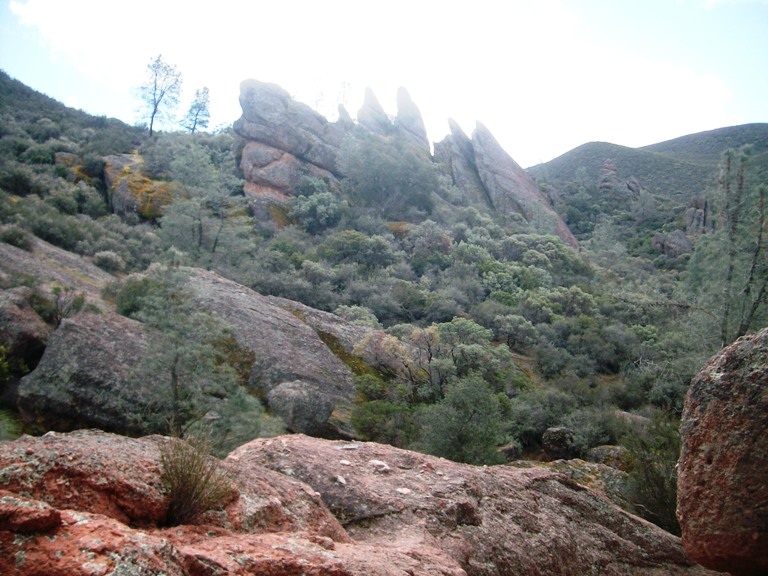
Pinnacles National Monument, established in 1908 by President Theodore "Teddy" Roosevelt, was a spectacular place to visit. Created millions of years ago by volcanic activity, her unique spires, monolith rock formations, and caves become both the natural playground to people and home to the wild alike. While rock climbers scale the sides of crags and young children and adults explore the cool and dark caves, raptors nest and raise their young on the rock formations and bats roost, hibernate and raise their little ones inside the caves.

With a broad geographic scale of 26,000 acres, diverse flora and fauna thrive in Pinnacles National Monument. The park has the greatest number of bee species per unit area of any place ever studied. It is also a natural habitat to 14 of the 24 bat species in California, and since 2003, is home again to California condors. Chapparal vegetation form about 80 percent of Pinnacles' flora. Chapparals are drought-tolerant, highly flammable and non-deciduous (non-leaf-dropping) woody shrubs with hard evergreen leaves.

We were blessed with great weather (considering that the day before, we had heavy downpour in the Bay, which I have to say was most welcome after months of drought). Many of us really enjoyed walking inside the dark Bear Gulch caves. These talus caves were formed when huge boulders fell and lodged themselves between the crevices at the lower part of the rock formations, creating these maze-like, narrow passages for people to walk through. An underground stream flows through these caves as well making the walk extra interesting. The Bear Gulch Cave Trail from the parking lot to Bear Gulch caves was an easy walk (about a mile's hike each way) and highly doable for youths and young children. We found our way to the reservoir and had a pleasant picnic lunch there.

Directions to the Pinnacles' east entrance from San Francisco Bay area (~1.5 hours each way):
Take Hwy 101 south through the city of Gilroy to Hwy 25 south. On Hwy 25, go through the town of Hollister and continue about 30 miles to Hwy 146. Turn right on Hwy 146, then turn left into the Pinnacles Campground to check in at Pinnacles Visitor Center. There is a day fee of $5 per vehicle to enter the park. From the campground, the Bear Gulch Area is 3.5 miles further into the park along Hwy 146.

All glory and praise to God for a wonderful day in nature with the children! :)

Above left: Passing a farm on Hwy 25 en route to Pinnacles National Monument


Above: Wild flowers at Pinnacles


Above left: A beetle; Above right: A lizard

You may also like: Skyline Ridge Open Space Preserve; Negative Tide @ Half Moon Bay